Efficacy of awake prone positioning in patients with covid-19 related hypoxemic respiratory failure
Weatherald J, et al. · BMJ, 2022
PMID: 36740866Abstract
Keep your thinking beside it.
Turn a PubMed abstract into a thoughtful appraisal. A little structure for the numbers, the questions, and your own conclusions.
Weatherald J, et al. · BMJ, 2022
PMID: 36740866Adults with covid-19 related hypoxemic respiratory failure
Awake prone positioning
Usual care
Endotracheal intubation
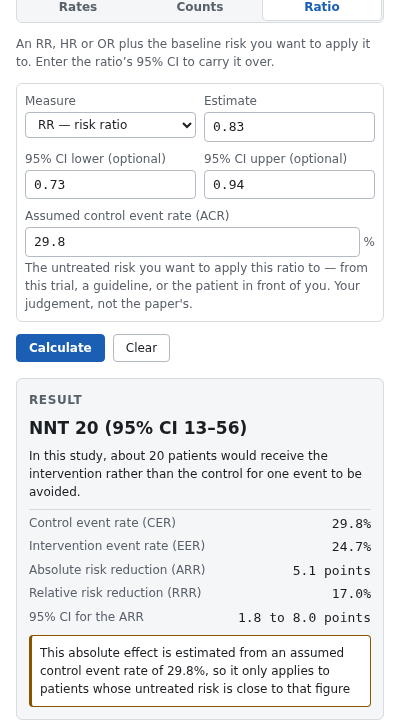
NNT 95% CI: 13–56. Estimated using an assumed baseline risk of 29.8%.
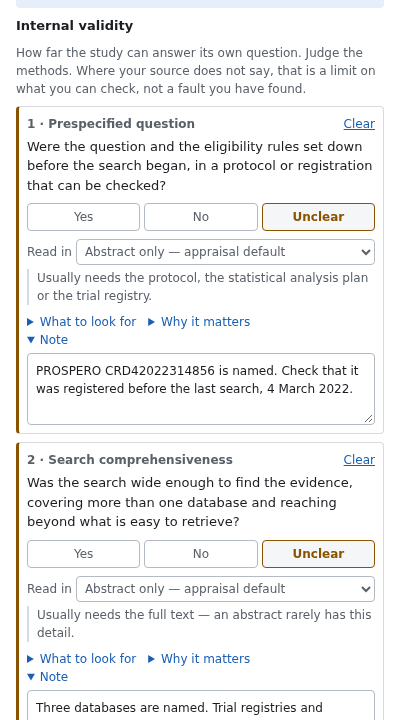
Were the question and eligibility rules prespecified?
UnclearCheck the protocol registration date against the last search.
Four connected steps. One place to think.
Right beside the PubMed paper you’re
reading.
Identify the design. Put the population, intervention, comparison, and outcome into your own words.
DESIGN + PICO 02Move from relative results to absolute risks and NNT. Confirm the numbers before you use them.
ARR · RRR · NNT 03Work through a checklist for the study design. Record what you know and what needs the full text.
CRITICAL APPRAISAL 04Pull your appraisal into a one-page summary. Add your bottom line and take it to the discussion.
MARKDOWN + PLAIN TEXTA relative risk of 0.83 only tells part of the story. Move the baseline risk to see why context matters.
Illustrative calculation with fixed RR 0.83; uncertainty is not shown here. The extension includes 95% CIs when calculable. See the worked example ↗
A design-specific checklist explains what to look for and why it matters. You make every judgement.
A prompt to check the full text. Not an automatic verdict.
Follow a real appraisal of a published BMJ meta-analysis, from the clinical question to the reader’s bottom line.
Watch the 33-second walkthroughActual extension recording. No sound, no sign-up.No account. No analytics. No server holding your appraisals. Your work is saved in your browser, ready to export or delete whenever you choose.
Read the privacy policyIf you request the NCBI fallback, only the article’s PubMed ID is sent with the tool’s contact details. Your notes stay local.
It provides a structured appraisal workspace: study design, PICO, effect calculations, and a checklist. You confirm the inputs, assess the evidence, and write your own bottom line. Always check the full text.
Randomized controlled trials, cohort studies, case-control studies, cross-sectional studies, diagnostic studies, and systematic reviews / meta-analyses have their own checklists. An unclear design has a general checklist to help you get started.
Yes. The core workflow runs locally in Chrome or Edge with no account. Your appraisals are saved per article in the browser. You can copy summaries as Markdown or plain text, or download them.
It is an educational aid for critical appraisal and journal club preparation. It gives no clinical advice or treatment recommendations. Verify the results and your interpretation against the full text.
Your next journal club starts with a better question.
Early access · Install from source using the GitHub instructions.
Chrome Web Store
listing coming soon. Chrome and Edge supported.